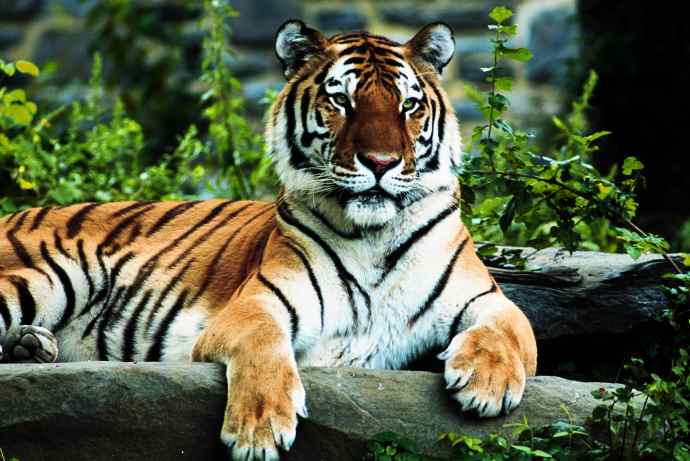
| Amur, or Siberian, tiger | Found in eastern Russia mainly, with some in northeastern China northern North Korea. | Lives in thick forests that are covered with snow in winter | Paler colouring, with brown rather than black stipes. White ruff of fur round neck. Largest cat in the world | Up to 3.3m head to tail, about 300kg | Less than 350 in the wild |
| Bengal tiger | Found in India, Nepal, Bangladesh, Bhutan and Burma (Myanmar) | From cold Himalayan forests to hot swamps to wet forests of north India to dry forests of Rajasthan | Reddish orange fur with narrow black , grey or brown stripes. Underside is creamy white | Up to 2.9m head to tail, about 140 kg | Approx 3, 500 in the wild |
| Indochinese tiger | Mainly in Thailand, but also Burma, Cambodia, Laos, southern China, Vietnam, parts of Malaysia | Live in forests in hilly to mountainous areas | Reddish orange to dark yellow fur with black or dark grey stripes | Up to 2.7m head to tail, about 115kg | Less than 1000 in the wild |
| Malay, or Malayan, tiger | Found only in the Malaysian part of the Malay peninsula. | Hilly forest areas because lowland forests have been cleared for rubber and palm oil plantations. | Appearance similar to Indo-Chinese tiger: it was not until 2004 that it was classified as a different subspecies. | Up to 2.7m head to tail, about 120kg | About 500 in the wild. |
| South China, or Amoy, tiger | Found in central - eastern China | Moist forests | Short broad stripes widely spaced | Up to 2.5 metres head to tail, about 150 kg | 20-30 in the wild The most critically endangered of the tigers, and possibly already extinct |
| Sumatran tiger | Found only on the island of Sumatra | Lives in forests, lowland to mountain areas | It is the darkest and smallest of the tigers, suitable for its rainforest habitat | Up to 2.4m head to tail, 90 kg | Critically Endangered, about 240 left |
Tiger

Beautiful Tiger
Wednesday, April 27, 2011
all tigers that are left and info

Wednesday, March 30, 2011



Tuesday, March 29, 2011


all types of tigers.
- The Bengal tiger lives in forested areas around the Indian sub-continent. Population estimates of approximately 4,000 make it the most populous of all tiger subspecies.
- Indo-Chinese tigers live forested areas of South East Asian states such as China, Thailand and Myanmar. This species ranks as the second most populous with maybe around 2,000 living in the wild.
- Sumatran tigers live on the island of Sumatra, Indonesia. They are the smallest of the tiger species and there might be around 400 living in the wild.
- Siberian or Amur tigers hold the distinction of being the biggest of the world's big cats. They live along the forests of the Amur River, a natural boundary line between Russia and China on the east coast. They are endangered, however, population estimates taken over the past decade show that 400-500 remained steady.
- South China tigers live in south-central China, and are commonly recognized as the most endangered tigers in the world. The Chinese government now gives them the same status as the Panda, and is actively pursuing a conservation program. Population estimates are difficult to establish. There may be a couple of dozen or so living in the wild and another sixty or so in zoos.
why do tigers have stripes?
No one knows why tigers have stripes, scientists think that the stripes act as camouflage,and help tigers hide from their prey while they hunt. tigers stripes are like human fingerprints;no two tigers have the same pattern of stripes.Most tigers have an orange coat with dark brown or black stripes accented with white.
Thursday, March 24, 2011
Appearance and Behaviours
Most tigers are orange-brown or dark yellow with dark brown, grey or black stripes. There are patches of white fur on their faces and ears. There is a white mark on the back of each ear so that from behind it looks like the tiger is watching, particularly in a shadowy forest habitat. This is a defence marking. Tigers have white fur on their stomachs. A tiger's stripes helps it to get close to prey when it is hunting. The stripes camouflage the tiger, helping it to blend into the grasses and edges of forests where it lives. Each tiger's pattern is different, like human fingerprints
did you know?
 A white tiger is not a subspecies. The original was captured in India, and was a true 'accident', or mutation, but was then bred to produce white cubs. White tigers today are generally part Siberian and part Bengal. They are bred in captivity by in-breeding animals that are closely related. White tigers would not survive in the wild because they are not camouflaged like gold and black tigers are. In attempting to breed white tigers, there are many birth defects and cub deaths.
Subscribe to:
Posts (Atom)